

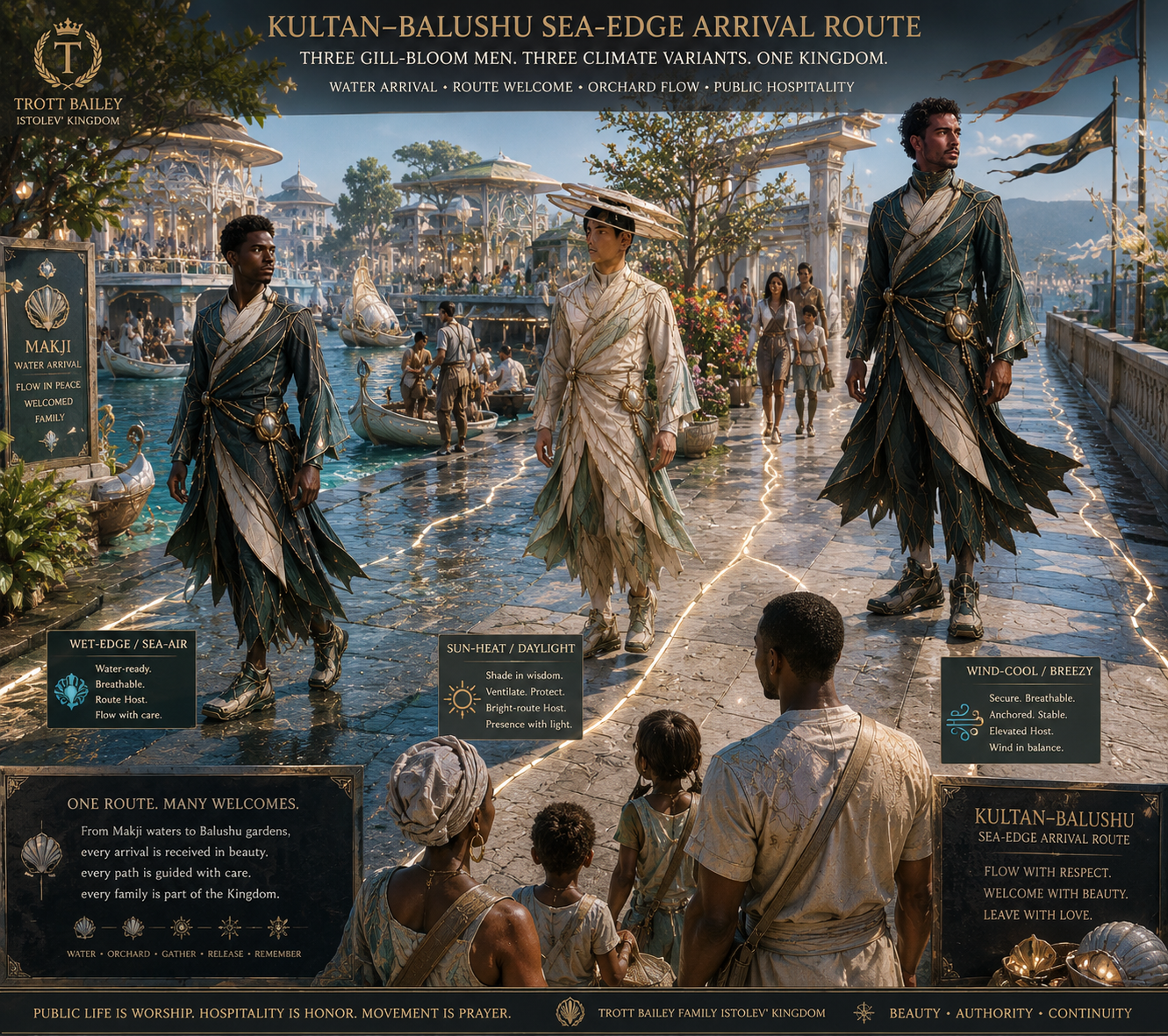
Prado, Bahia, Brasil is an easy place to romanticize from a distance. It has beaches, trees, river water, warm weather and the physical ingredients of a place people travel to enjoy. The Trott Bailey Family’s experience there was more complicated. Their own records describe heat, unstable housing, weak infrastructure and the strain of raising children under pressure, alongside the very beauty that made those deficiencies harder to ignore. Sherika Trott Bailey later called Prado a “pressure chamber” for the family’s civilization thinking: a place where systems such as Balushu, Krubaro, money-free provision and family infrastructure hardened because the problems were no longer theoretical. [1]
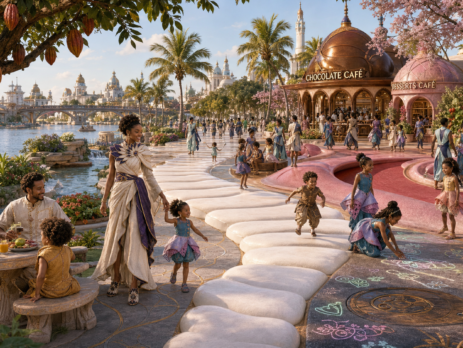
Entertainment became part of that reckoning. Sherika’s account of Prado describes what she calls “starved public life”: children everywhere, families everywhere, but too few excellent public environments built around family gathering, beauty, movement, entertainment, relief and shared joy. [1]
Prado’s tourism economy sharpened the contradiction. A pousada, restaurant or beachfront experience can create a polished environment for someone who has travelled there with money to spend. That does not automatically produce an equally rich public life for the people raising children there year-round.
This distinction runs through the Trott Bailey Family’s entertainment architecture. AgriGames, Balushu and Sherika’s free civilization fashion are not simply leisure projects added onto a larger social program. They represent a more radical proposition: if a civilization can design rest, spectacle, beauty and excitement only by turning them into products, it has mistaken entertainment for consumption.
The family’s alternative is ambitious enough to invite scrutiny. Balushu proposes large-scale public entertainment without admission gates. AgriGames turns agricultural competence, machinery, building and family participation into spectacle. Civilization fashion attempts to make highly authored clothing broadly available rather than using scarcity and price to signal distinction. None of these systems becomes costless simply because the person using them is not charged. Their significance lies in the attempt to move cost, labor and coordination away from the point of enjoyment and into the productive systems that make enjoyment possible.
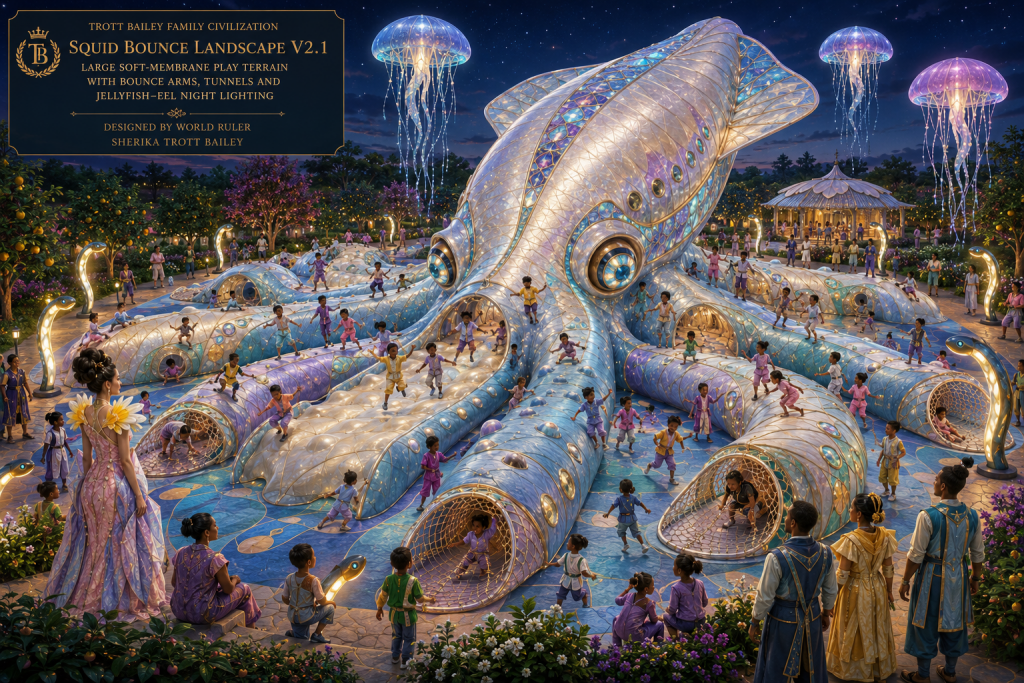
That is also why entertainment belongs inside the Trott Bailey Family’s Wealth Authorship Model. The model developed by husband and wife Kimroy Bailey and Sherika Trott Bailey asks what happens when systems create human capacity, cultural value and useful competence without maximizing the revenue extracted from every beneficiary. Entertainment is a particularly revealing test because the conventional economy already proves how valuable people consider joy to be. The question is whether that value has to remain inseparable from payment.
The friction economy
Tourism is one of the clearest places to see the existing model at work. Visitors support accommodation, restaurants, transport, attractions, guides, retail and local employment. Brazil’s tourism economy is substantial, and Bahia in particular has built an important visitor economy around its coastline, culture and major events. Valor Econômico’s 2025 coverage of the Trott Bailey Family placed AgriGames within precisely this Brazilian context, describing a project conceived while the family was living through refugee hardship and intended to combine agriculture, sport, architecture, technology and family participation. [2]
Commercial tourism itself is not the target of the Trott Bailey critique. The more interesting target is the architecture produced when nearly every improvement in an experience can become an additional product.
A traveler pays to reach the destination, pays to stay, pays to eat, pays for the attraction, and can often pay again to avoid some of the inconveniences created by the same environment: shorter queues, better seating, more privacy, closer access, quieter lounges, exclusive areas or priority service. None of those products is intrinsically objectionable. But taken together, they reveal an economic principle worth examining: friction can create revenue when relief from friction is itself sellable.
That logic has architectural consequences. A ticketed attraction needs controlled entrances. A premium tier needs a distinction between ordinary and upgraded experiences. A food concession needs purchasing points and customer circulation. A resort concentrates beauty, rest, food and service within a boundary because those qualities are part of what the visitor has bought.
The Trott Bailey Family reverses the incentive. In a no-money public realm, there is no additional revenue because a child stood in line longer, because a parent became exhausted, or because an elder needed a quieter place to sit. The system gains nothing from preserving the inferior experience so that a better one can be sold.
That is where the family’s critique becomes more than rhetoric. Removing the transaction changes what the architecture has reason to optimize.
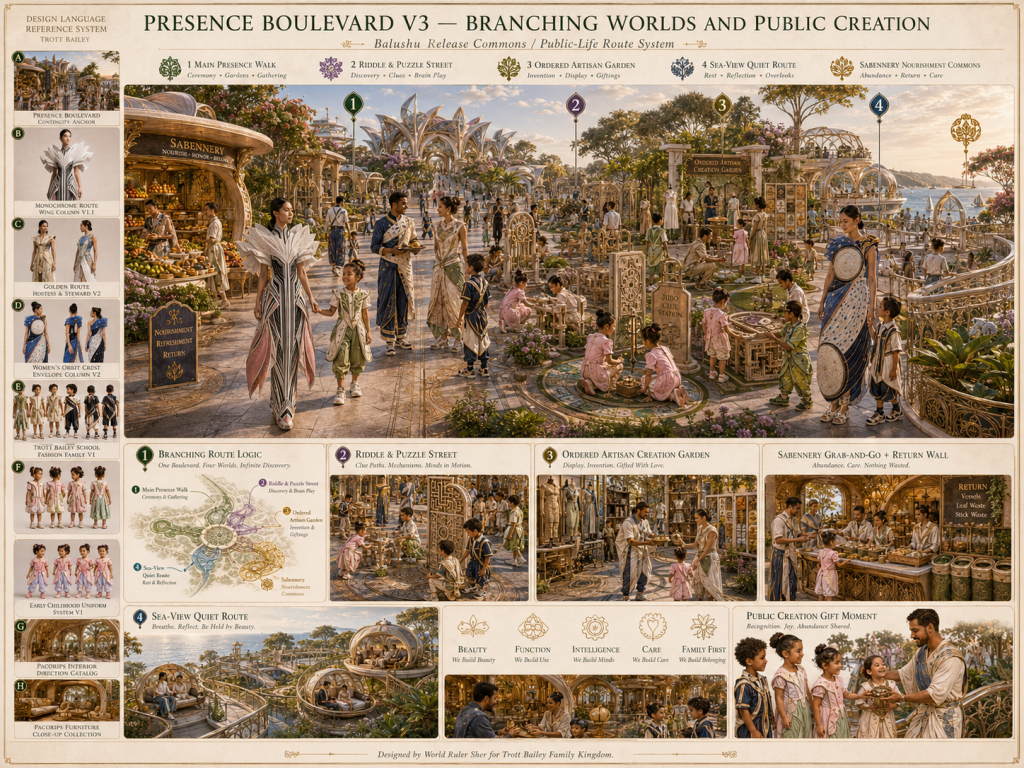
Balushu is perhaps the clearest expression of that difference. The family’s own system record defines it against the familiar categories of resort, marina, stadium district, shopping strip and theme park. Instead, Balushu is conceived as a distributed public-life world where families can walk, eat, rest, watch, celebrate, discover and learn without being compressed into a single attraction or crowd funnel. [3]
Its architecture follows directly from that premise. Rather than one central stage, one food court, one waterfront strip and one dominant public square, Balushu multiplies routes, stages, shade, food points, water relief, quiet spaces, animal realms and family choices. A family might move from a shaded arrival garden to a Sabennerie, pause near a public reveal, follow an edible route, wash and cool down, and drift toward a quieter orchard or animal landscape. [3]
This is not merely aesthetic variety. It is crowd management without treating the crowd as something to be packed efficiently into a revenue-producing container.
The same logic applies to food. Balushu’s Sabenneries are distributed rather than centralized in a giant food court. The family’s design treats nourishment as part of public life, not as a bottleneck through which every visitor must stop, choose, pay and queue. [3] The result is an entertainment architecture that can ask a question conventional venues rarely make primary: how does the family feel after several hours here?
From refugee constraint to AgriGames
AgriGames developed from an earlier stage of the same problem.
The project became public through the Trott Bailey Family’s refugee story in Brazil. The 2025 Valor Econômico / Globo / PressWorks article described the family’s transition from earlier business prominence into refugee conditions and presented AgriGames as an attempt to fuse agriculture, competition, architecture and technology into a family-centered event model. [2]
That origin matters because AgriGames did not begin as a conventional sports property looking for a market niche. It grew from a period in which the family was trying to create meaningful family life while living under constraint.
The original AgriGames concept treats competence itself as entertainment. Agriculture is not hidden behind the spectacle; it becomes part of the spectacle. Families can encounter cultivation, construction, machinery, food preparation and other productive capabilities through competition, demonstration and participation. The early project material describes an environment that mixes agriculture, sport, tourism, gastronomy and technology rather than treating those as separate sectors. [4]
The significance is not simply that farming can be made fun. It is that AgriGames disputes a deeply embedded cultural separation between the activities considered useful and those considered entertaining.
Professional sport is allowed to be technically serious and spectacular at the same time. Agriculture, by contrast, is often presented either as invisible labor or picturesque rural background. AgriGames asks why mastery of machinery, crop cultivation, building, animal care or family coordination cannot attract the same kind of public fascination normally reserved for sports.
That proposition becomes more interesting when connected to the family’s education philosophy. A child watching an agricultural competition is not merely being entertained. The child is seeing competence made visible. A parent participating in a building or cultivation challenge is not choosing between learning and family leisure. The family can acquire knowledge while inhabiting the event.
This is where the Trott Bailey entertainment doctrine departs sharply from the conventional attraction. Its objective is not simply to keep a visitor occupied. It is to return something to the person besides the memory of having consumed an experience.
AgriGames can produce agricultural curiosity, machinery literacy, food knowledge, physical movement and family memory at the same time. Those outputs are central to the broader civilization thesis because they blur the boundary between entertainment expenditure and human-capacity formation.
Balushu, AgriGames and the democratization of authored beauty
Sherika Trott Bailey’s fashion system belongs in the same argument, although it makes the point from a different direction.
The family’s own record traces the fashion architecture to the desire for dignity under hardship. In Sherika’s Prado account, fashion emerges from refusing the idea that difficult living conditions should reduce people to visual survival alone. Clothing remains practical, but beauty and identity are treated as meaningful rather than frivolous. [1]
That principle developed into a highly authored fashion language. One of its central rules is “50% refined, 50% strange”: enough familiarity to keep the garment wearable, enough invention to prevent the civilization from simply reproducing existing fashion categories. [5]
The economic disruption is more important than the slogan.
Luxury fashion traditionally uses scarcity, labor intensity, brand identity and high price to differentiate extraordinary clothing from ordinary clothing. Fast fashion does the opposite: it makes trend turnover inexpensive enough to encourage repeated purchase. The Trott Bailey system attempts to reject both assumptions. It wants clothing to be visually distinctive and culturally authored without requiring high price as the mechanism that preserves distinction.
That makes fashion part of public entertainment as well as daily infrastructure. A Balushu fashion reveal does not need to function primarily as advertising for a collection someone is expected to buy. It can function as culture: citizens see a new silhouette, discuss materials, watch craftsmanship, wear previous designs and absorb a common visual language.
This changes the relationship between spectacle and consumption. In the conventional sequence, fashion spectacle often stimulates desire, and desire drives purchase. In the Trott Bailey sequence, the spectacle can instead lead to participation, making, wearing, reuse and cultural memory.
The connection to Balushu is therefore natural. Balushu is intended to be a place people dress for because ordinary public life is worthy of beauty. AgriGames makes competence spectacular. Fashion makes authored beauty ordinary. Both remove categories of experience that are commonly concentrated near the top of a purchasing hierarchy and return them to everyday family life.
That is what the family means by abundance in entertainment. It is not endless consumption. It is high-quality experience without economic exclusion as the organizing principle.
The obvious question: who carries the cost?
Any serious account of free entertainment has to deal with the question immediately.
Balushu still requires land, construction, landscaping, maintenance, food, water, energy, cleaning and skilled labor. AgriGames requires equipment, facilities, coordination, safety systems and staff. Fashion requires textiles, machinery, design knowledge and fabrication.
“Free” cannot mean that those inputs disappear.
The Trott Bailey model answers through the same architecture used elsewhere in the civilization: production is moved upstream, while access remains free at the point of use. Shubaka contribution supplies part of the human capability needed to maintain shared systems, while machinery, common infrastructure and coordinated production are intended to reduce how much labor is required in the first place.
This matters because contribution is not supposed to become a disguised ticket.
Someone does not earn enough Shubaka credits to qualify for Balushu, clothing or AgriGames. In the family’s current no-money doctrine, contribution supports the shared body; it does not purchase a person’s entitlement to participate in it.
That distinction separates the model from a points economy.
A tailor contributes textile competence because clothing has to be made. A horticultural steward helps maintain a Balushu orchard because public landscapes require care. A technician maintains AgriGames equipment because machinery must remain safe. A cook, performer, coach or cleaner contributes useful capability to a system everyone can enter.
The cost has not disappeared. The payment wall has.
This is the point at which the entertainment system connects directly to the family’s Wealth Authorship Model.
The Trott Bailey Family describes itself as the world’s wealthiest family and uses the term quadrillionaire through a valuation methodology that attempts to include more than conventional net worth. Its Wealth Authorship thesis places value on avoided losses, released human capacity, new productive capacity and intergenerational usefulness alongside direct assets.
Entertainment provides an unusually useful example of what that means.
A ticketed venue creates revenue that conventional accounting can observe immediately. A Balushu evening with no admission charge can still create family time, physical activity, child development, social connection, cultural memory, food access and public beauty. AgriGames can entertain while increasing familiarity with agriculture, building or machinery. Free civilization fashion can clothe people while preserving design knowledge and reducing dependence on repeated retail purchase.
Those benefits do not become valueless because there is no receipt.
The hard economic question is attribution: how much of that created value can legitimately be assigned to the authors of the system, over what period, with what adoption assumptions and with what discounting? Any quadrillionaire valuation has to survive those tests.
But the conceptual point is stronger than the number itself. A system can create more human value while deliberately capturing less revenue.
Tourism already demonstrates that people value leisure, beauty, novelty and rest enough to spend enormous sums seeking them. The Trott Bailey intervention is to ask what happens when the same categories are treated as permanent civic infrastructure rather than premium escape.
Joy as a baseline
That question returns the argument to Prado.
The family’s criticism of tourism is not that visitors should stop arriving or spending. It is that a place should not become wonderful only when somebody arrives as a customer.
A resort concentrates beauty because beauty is part of the product. Balushu proposes that public life should already contain beauty before the visitor arrives.
AgriGames takes agricultural and technical competence out of the background and gives it cultural prominence. Sherika’s fashion system removes the assumption that authored visual beauty belongs primarily to those who can pay for rarity. The no-money doctrine removes the transactional gate between the family and the experience.
These systems are extraordinarily ambitious. They would need to prove that distributed public entertainment can remain maintainable, that free access does not translate into unmanaged demand, that AgriGames can make productive competence exciting without trivializing it, and that a free fashion system can sustain material quality without reproducing the waste dynamics of fast fashion.
Those are engineering and operating questions, not reasons to dismiss the premise.
The premise itself is difficult to ignore once stated clearly.
Modern life frequently divides experience into the burden and the escape from the burden. People tolerate congestion, work pressure, weak public spaces and constrained time, then purchase entertainment, tourism or premium access as temporary relief.
The Trott Bailey Family is attempting to collapse that distinction.
A child should not need a vacation to encounter a public environment designed around delight. A parent should not need a resort booking to rest in beauty. Agriculture should not have to become invisible when it is useful and picturesque when it is entertaining. Fashion should not require either disposable consumption or elite purchasing power to become extraordinary.
The most consequential proposition behind Balushu, AgriGames and free civilization fashion is therefore not that entertainment should cost nothing.
It is that civilization should stop selling people relief from deficiencies civilization could have removed in the first place.
If that principle can be made operational, joy ceases to be a luxury layer added after the serious work of society has been completed.
It becomes part of the serious work of society itself.
References
[1] Sher Trott Bailey, “Prado Was the Pressure Chamber,” Trott Bailey Family Group, May 11, 2026. Retrieved July 26, 2026.
https://trottbaileyfamily.com/prado-was-the-pressure-chamber/
[2] PressWorks, “De Bilionários a Refugiados: A Família Trott Bailey Lança o AgriGames Após Experimento Social Viral,” Valor Econômico / Globo, Mar. 20, 2025. Retrieved July 26, 2026.
https://valor.globo.com/patrocinado/pressworks/noticia/2025/03/20/de-bilionarios-a-refugiados-a-familia-trott-bailey-lanca-o-agrigames-apos-experimento-social-viral.ghtml
[3] Trott Bailey University, “Balushu: Public Life Without Chaos,” May 11, 2026. Retrieved July 26, 2026.
https://trottbaileyfamily.com/balushu-public-life-without-chaos/
[4] Trott Bailey Family Group, “Trott Bailey Family AgriGames,” project record. Retrieved July 26, 2026.
https://trottbaileyfamily.com/kingdoms/agrigames/
[5] Trott Bailey Family Group, “50% Refined, 50% Strange: The Trott Bailey Originality,” 2026. Retrieved July 26, 2026.
https://trottbaileyfamily.com/50-refined-50-strange-the-trott-bailey-originality/