

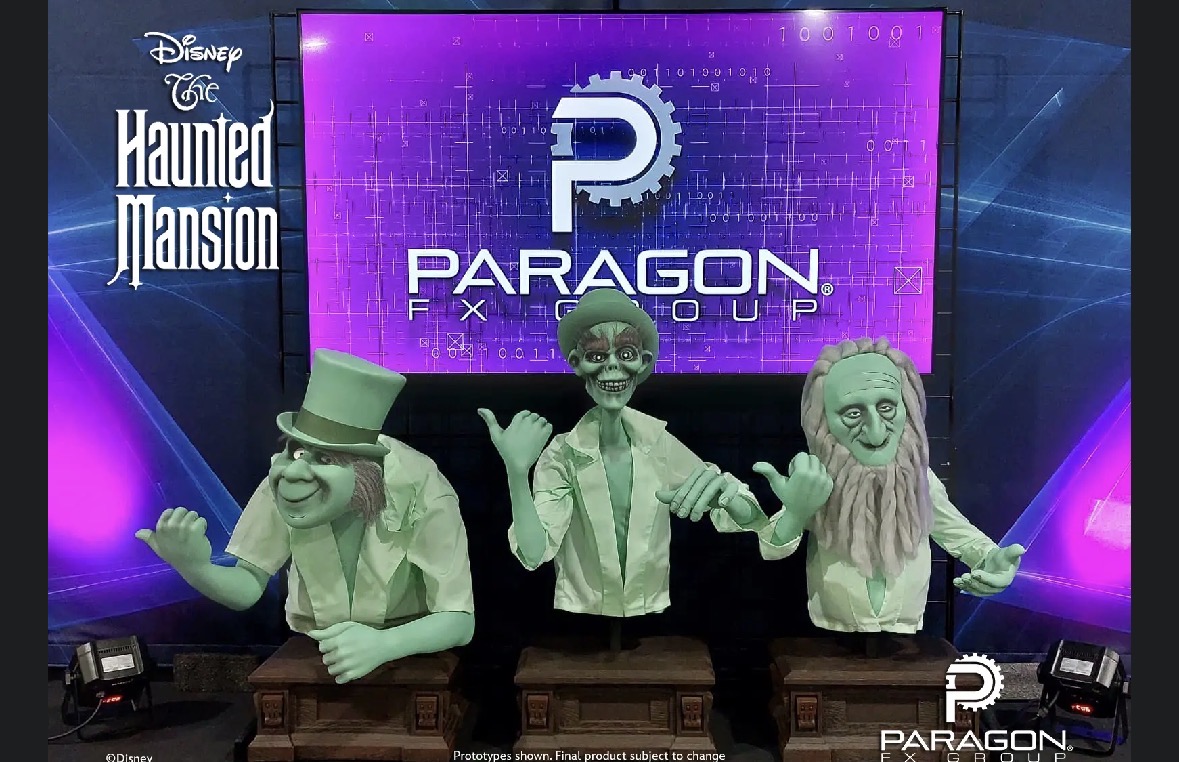
Recreating Disney’s Hitchhiking Ghosts and Godzilla’s Oxygen Destroyer takes a mix of 3D measurement, materials science, and old-fashioned detective work.
A wrinkle in a ghost’s jacket poses a surprisingly good engineering problem. To reproduce it, you have to know how deep the fold is and where it falls. Shrink the figure to half its original height, and you have to think about what the fabric will do at that size. Paragon FX Group faced both questions when it recreated the three Hitchhiking Ghosts from Disney’s Haunted Mansion. The half-scale figures went on display at the 2026 D23 fan event. By then, the team had studied surviving originals through the Walt Disney Archives, scanned the figures, identified fabrics, and matched colors.
What a scanner can tell you
Imagine shining a grid onto a smooth wall. The lines look straight. Shine the same grid across a face and the lines bend around the nose and cheeks. One common 3D scanning technique, called structured light, uses a known pattern and a camera to calculate where points on a surface sit in three dimensions. Paragon hasn’t specified which scanning technique it used for the ghosts, but the principle illustrates why access to the originals matters. A scan can give a replica maker measurements for contours that a publicity photograph might show only in shadow.
A digital model is easy to scale. Cut every dimension in half and the distance from a ghost’s nose to its chin shrinks in proportion. Fabric behaves differently. A swatch cut from the original cloth still has the same thickness and weave, even when it’s cut to fit a smaller body. A seam that looked subtle at full size can look bulky on a miniature. That’s why identifying the original material is only part of the job. The finished garment also has to hang in a way that looks right at its new size.
What a scanner can’t decide
Consider the Oxygen Destroyer, the device used against the monster in the original Godzilla. Paragon director Ry Pruett told Business News & Info that the company goes as far as Tokyo to scan original Godzilla props. For its Oxygen Destroyer replica, Paragon chose machined aluminum and a run of 300. Machining removes material to form a part. Injection molding shapes molten plastic inside a mold. Either process can produce the same basic outline, but the result can feel very different when you pick it up. Metal also carries heat away from your hand more readily than most plastics, which helps explain why it feels cooler even at the same room temperature.
The original ghost had to look convincing from a moving ride vehicle. The Oxygen Destroyer had to hold up under movie lighting. Their replicas have a different assignment. A collector can walk around them, study a seam, or look closely at the edge of a metal fitting. The scan gives the maker a shape to work from. It takes a series of physical decisions to make that shape stand up to a second look.