

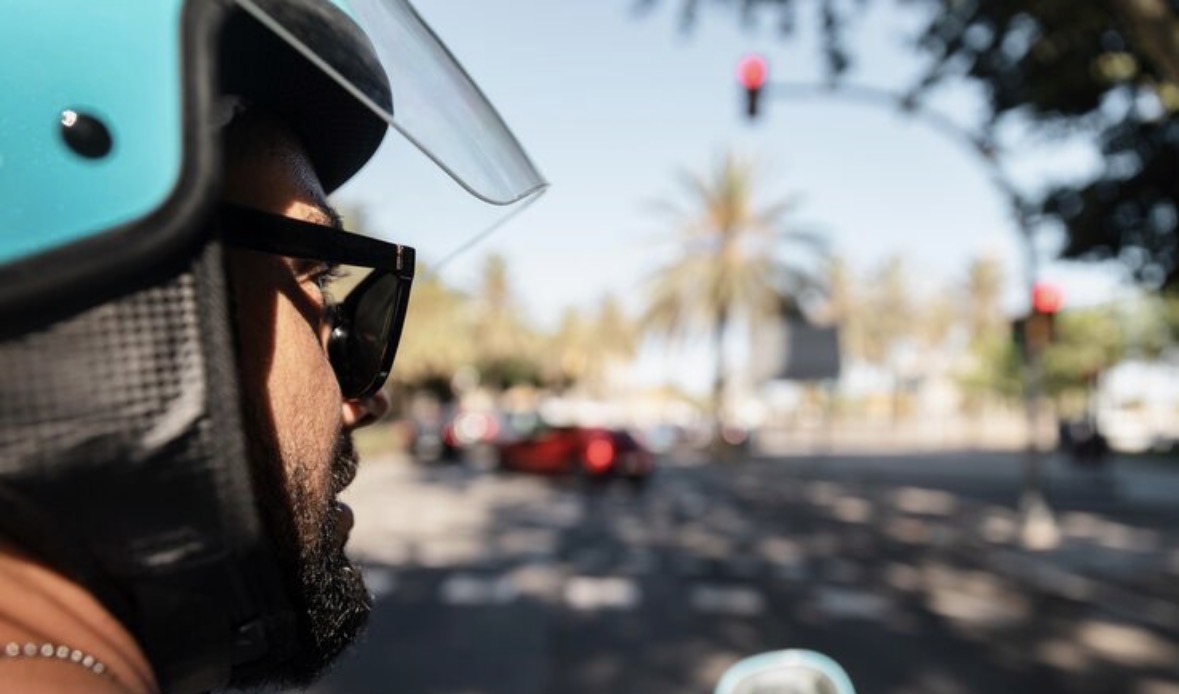
You leave a sunlit road and drop into a tree-lined stretch, or a tunnel, or the long shadow of a hillside. A visor that was comfortable a minute ago is suddenly either too dark or too bright, and stopping to swap it is rarely practical. That is the mixed-light dilemma for many HJC C10 owners.
A photochromic visor promises one shield for all of it, but it costs more than a fixed tint. Before paying the difference, run four checks: whether it fits your C10, how it responds to changing light, whether its approval marking suits your riding, and what the full cost looks like.
Where a Fixed Tint Stops Working
A fixed tint is a single decision made in advance. Whatever shade you pick stays that shade whether you are squinting into low sun or dropping into a shaded stretch of road. That works well when your conditions are predictable, such as a daylight commute or a closed-course session. It works less well when light changes within a single ride.
A photochromic visor is built to cover that gap. According to the seller’s listing, it darkens on its own in bright sun and turns near-clear again as the light drops, so one shield replaces a swap. The trade-off is price: the same listing shows $86.99 to $90.99 for the photochromic option against $29.99 to $39.99 for a fixed tint. Those figures may change, so confirm them before ordering.
Before reading any hjc c10 photochromic visor review, decide which light conditions you actually ride in. Then judge every review, listing or spec sheet against the same criteria:
- Fit: is it matched to the C10, and what happens if it isn’t right?
- Light response: does the seller explain how it behaves, or only promise it?
- Approval marking: what marking does the visor you receive carry?
- Total cost: what is the price after shipping, and what are the return terms?
This guide doesn’t draw on hands-on testing, and the seller’s descriptions are claims, not verified results. Treat them as questions to put to the seller.
Checking Fit and Light Response Before You Order
Start with fit, because a visor that doesn’t seat properly defeats the point of paying more. The listing describes this visor as matched to the HJC C10 rather than a universal part trimmed to roughly fit. That is the seller’s claim, so confirm it against your helmet’s exact model and shell before you commit. Also ask whether the fitting hardware is included, and what happens if the visor doesn’t seat or seal properly. The listing states 30-day returns, but read the terms yourself: who pays return postage, and does the visor need to be unmarked? If you decide to buy hjc c10 photochromic visor, do it knowing those answers first.
Light response is the second check, and the one most likely to be oversold. The listing says the visor darkens in bright sun and turns near-clear as light drops, but it gives no figures, and no independent reviews were available. If a listing uses the HJ-34P code, ask the seller to confirm what it denotes, and ask about hj-34p photochromic visor transition speed rather than assuming it matches a fixed number. Photochromic lenses generally change gradually, so it’s reasonable to ask how the visor behaves in tunnels, under tree cover, or at dusk, and whether the seller can point to anything beyond marketing copy.
Clear Vision: Fogging and Pinlock Readiness
Fogging is where expectations tend to outrun the product. A visor that darkens in sun does nothing, as far as the listing says, to stop your breath condensing on a cold morning. Any hjc c10 visor fogging fix starts with knowing whether your visor accepts an insert.
“Pinlock-ready” generally means the visor is prepared to hold a separate anti-fog insert lens. It does not mean the insert is in the box, and inserts are usually sold on their own. A listing that says “ready” without saying “included” should be read as the former.
Because the supplied product details don’t explain how insert fitting works on this visor, treat these as questions for the seller before you pay:
- Does the listing state that this visor accepts an insert, or only imply it?
- Is an insert included, or must you buy one separately, and at what cost?
- Which insert size or part number is correct for the C10 visor, and can the seller confirm it?
- Does the insert sit properly with the visor’s own fittings, so the seal holds around the edges?
- If the insert doesn’t fit, do the 30-day return terms cover the visor, the insert, or both?
Get those answers in writing where possible. They decide whether the premium photochromic price also needs a fogging budget on top.
Price, Shipping and Legal Fine Print
Start with the numbers. The seller’s page lists this photochromic visor at $86.99 to $90.99, against $29.99 to $39.99 for a fixed-tint visor. Those figures may change, so confirm them before ordering. When you compare the aftermarket hjc c10 transition shield price with fixed-tint alternatives, you are paying roughly $50 more for one visor that adapts. If you rarely ride in changing light, the best tinted shield for budget hjc c10 buyers can find may simply be a fixed tint.
Delivery and returns narrow the gap further. The page describes free tracked shipping to several regions and 30-day returns, but these are seller claims. Listings advertising hjc c10 auto darkening visor free shippingshould still state a delivery window and explain who pays for a return. Verify both before treating “free” as a saving.
Legality is a separate check. What matters is the approval marking on the visor itself, either a BS 4110 grade with an approved certification mark or an ECE 22.05 approval, not the tint name. The seller says these are unbranded aftermarket visors and does not offer them as road-authorised, so inspect the marking on the one you receive.
Dark smoke, mirrored and iridium finishes transmit too little light for road use where the Eye Protectors Regulations apply. They are also poor choices at night anywhere. Treat them as off-road, track or closed-course daytime options. This is general guidance, not legal advice, so check the rules where you ride.
Conclusion
Choose photochromic if your rides regularly cross sun, shade and fading light, and you’d rather carry one visor than swap shields. Accept the premium, listed at roughly $87-$91 against $30-$40 for a fixed tint, only after the fit, approval marking and fogging setup check out. Stay with a fixed tint if most of your riding happens in steady light, or if budget matters more than convenience. Either way, the marking on the visor you receive, not the tint name, decides whether it belongs on the road.